Why Isn't My Business on Google Maps? | Velocity Designs
You built a website. Maybe you even had someone optimize it for SEO. But when you search for your own business — or the kind of service you offer plus your city — you're nowhere to be found. Three or four other businesses show up in that map section at the top of the results, and yours isn't one of them.
It's a frustrating spot to be in, because it feels like you did the right things. The truth is, your website is only part of the picture. A huge piece of local search visibility happens outside your website entirely — and it's the piece most small businesses never touch.
A good website isn't the whole story
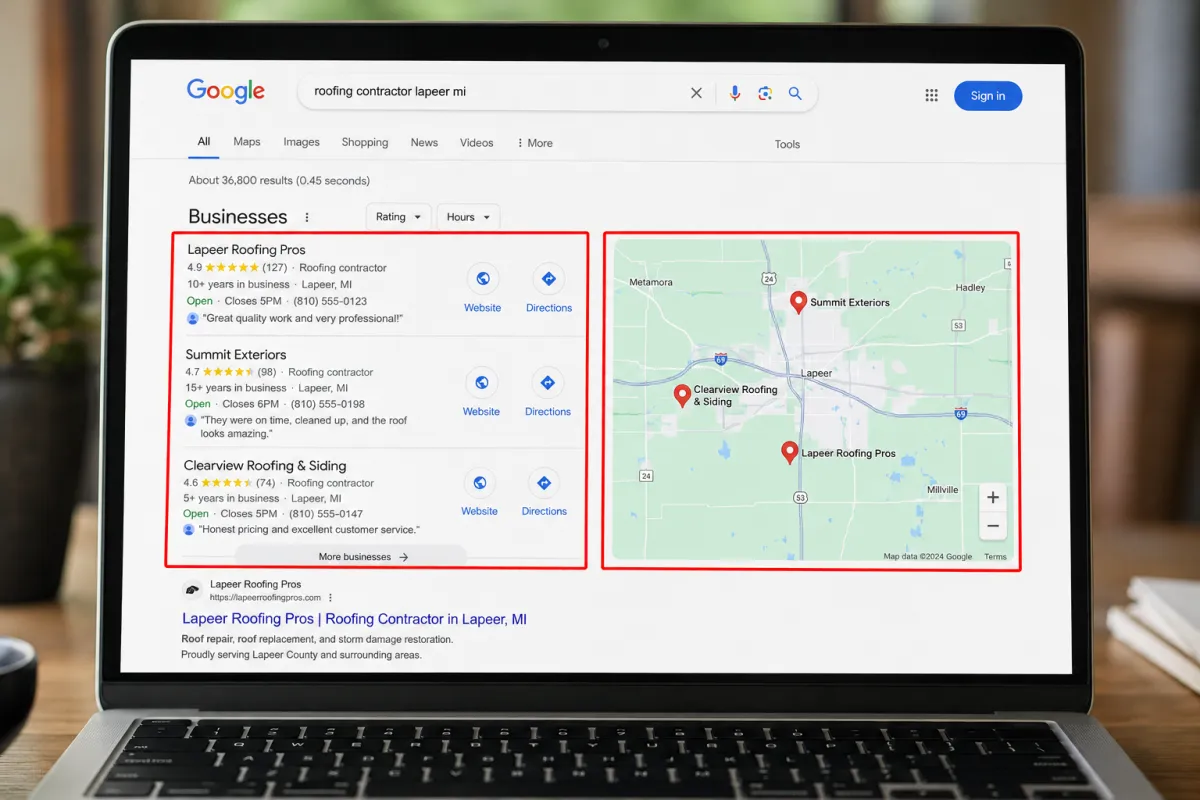
When someone searches for "[your service] near me" or "[your service] in [your city]," Google usually shows two things: a map with a handful of pinned businesses (the "local pack"), and then the regular list of website results below it.
Your website competes for that second section. The map section — the one most people look at first, because it's right at the top and shows businesses near them — runs on something different: your Google Business Profile, combined with how consistent and complete your business information is across the web.
You can have the best website in your city and still not show up in that map section, because Google isn't just looking at your website to decide who belongs there. It's looking at a much wider set of signals.
The usual culprits

Inconsistent business information (NAP). NAP stands for name, address, and phone number, and it's one of the most common — and most overlooked — issues. If your Google Business Profile lists your phone number one way, your Facebook page lists it slightly differently, and an old Yelp listing has your previous address, that inconsistency sends a confusing signal. Google can't be fully confident which information is correct, and that uncertainty can quietly hold you back in local rankings.
This happens more often than people realize. Businesses move, change phone numbers, update their name slightly, or get listed automatically on directories they never signed up for — and those old listings just sit there, unmanaged, for years.
An incomplete Google Business Profile. A lot of businesses set up their Google Business Profile once, years ago, and never touch it again. Meanwhile, the profile is missing things that matter: business hours aren't updated for holidays, there are no recent photos, the category isn't quite right for what the business actually does, services aren't filled out, and there hasn't been a post or update in ages. Google rewards profiles that look complete, current, and active — the same way an active social media page builds trust with customers, an active Google profile builds trust with Google.
No listings management at all. Beyond Google, there's a whole ecosystem of directories — Yelp, Bing Places, Apple Maps, Facebook, industry-specific directories — where your business may or may not be listed correctly, or listed at all. Most business owners have never looked at most of these. Each one is a small signal, and missing or wrong information across enough of them adds up to a real visibility problem.
What listings management actually does
Listings management is the process of finding everywhere your business is (or should be) listed online, making sure the information is accurate and consistent everywhere, and filling in the gaps where it's missing or incomplete.
In practice, that means:
Making sure your name, address, phone number, and website match exactly across Google, Yelp, Facebook, Bing, Apple Maps, and the other directories that matter for your industry and area.
Building out your Google Business Profile fully — accurate categories, complete service lists, current hours, and photos that represent your actual business.
Cleaning up or claiming old, duplicate, or outdated listings that are sending mixed signals.
Keeping things updated going forward, since this isn't a one-time fix — hours change, services expand, and listings need to stay current.
This is foundational, unglamorous work. It doesn't look exciting and you won't see it on your website. But it's often the missing piece between "has a good website" and "actually shows up when people search."
How this connects to your broader SEO
Local listings are one piece of a bigger local search picture. The other piece is your website itself — how it's structured, what it says, and whether it's built around the terms people actually search for in your area. One without the other leaves visibility on the table. A perfectly optimized website with messy listings still struggles to show up in the map pack. A clean, consistent set of listings pointing to a website that isn't built for local search still won't convert well once people land on it.
That's why listings management and SEO work best together — they're addressing different parts of the same problem, and most small businesses have gaps in both.
Find out where you stand
If you've never specifically checked your business listings across the web, there's a good chance something's inconsistent or incomplete somewhere — most businesses have at least a few issues without knowing it.
Get in touch and we'll take a look at how your business currently shows up across Google and the other places that matter, and what it would take to get your map presence matching the quality of your website.