How to Get More Google Reviews | Velocity Designs
93% of consumers read online reviews before they choose a local business. Before someone calls you, books with you, or walks through your door, there's a good chance they've already searched your business name and scrolled through what other people had to say.
So here's the question worth sitting with: when's the last time you actually asked a happy customer to leave you a review?
If you're like most business owners, the answer is "not recently" or "never." Meanwhile, the one customer who had a bad experience last month didn't need any encouragement at all — they left a review the same day. That's the gap. Happy customers stay quiet unless you ask. Unhappy customers don't need to be asked.
The good news is this gap is fixable, and it doesn't require a complicated system to start closing it.
Why most businesses are stuck with too few reviews
It's not that your customers don't like you. Most of the time, they're happy. They just don't think to leave a review — it's not on their radar, and even if it crosses their mind, life gets in the way before they open the app.
Meanwhile, every business is being judged against this invisible scoreboard. A potential customer comparing you to a competitor down the street might see that they have 80 reviews and a 4.8 rating, and you have 6 reviews and a 3.9. Doesn't matter how good your work actually is — on paper, you just lost that customer before you ever spoke to them.
The businesses with strong review counts usually aren't doing better work than everyone else. They're just better at asking.
The manual approaches (and why they fall apart)
Most business owners have tried something to get more reviews. Here's where the usual approaches tend to break down.
Asking in person. This works in the moment — a customer is standing in front of you, happy with the job, and you ask them to leave a review. The problem is consistency. You're busy, you're moving on to the next customer, and on a hectic day it's the first thing that gets skipped. Even when you do ask, the customer has to remember to do it later, find your business on Google, and actually write something. A lot drops off between "sure, I'll do that" and an actual review showing up.
Printed cards or QR codes. Some businesses hand out a small card with a QR code linking to their Google review page. It's a nice idea, but it relies on the customer holding onto a piece of paper, remembering it exists, and scanning it later. Most cards end up in a glovebox or a junk drawer. The ones that do work tend to work because the business owner also asked verbally — the card alone rarely does the job.
Follow-up emails. A step up, since at least it's automatic-ish — you send an email a day or two after the job asking for a review. But open rates on business emails are low, and even when someone opens it, clicking through to leave a review from an email on a desktop, then switching to find your Google listing, adds friction. Every extra step is a chance for someone to close the tab and forget.
None of these approaches are wrong. They just depend on memory, timing, and effort — yours and the customer's — lining up at the same time. When that doesn't happen consistently, your review count stalls.
What an automated review request system actually does
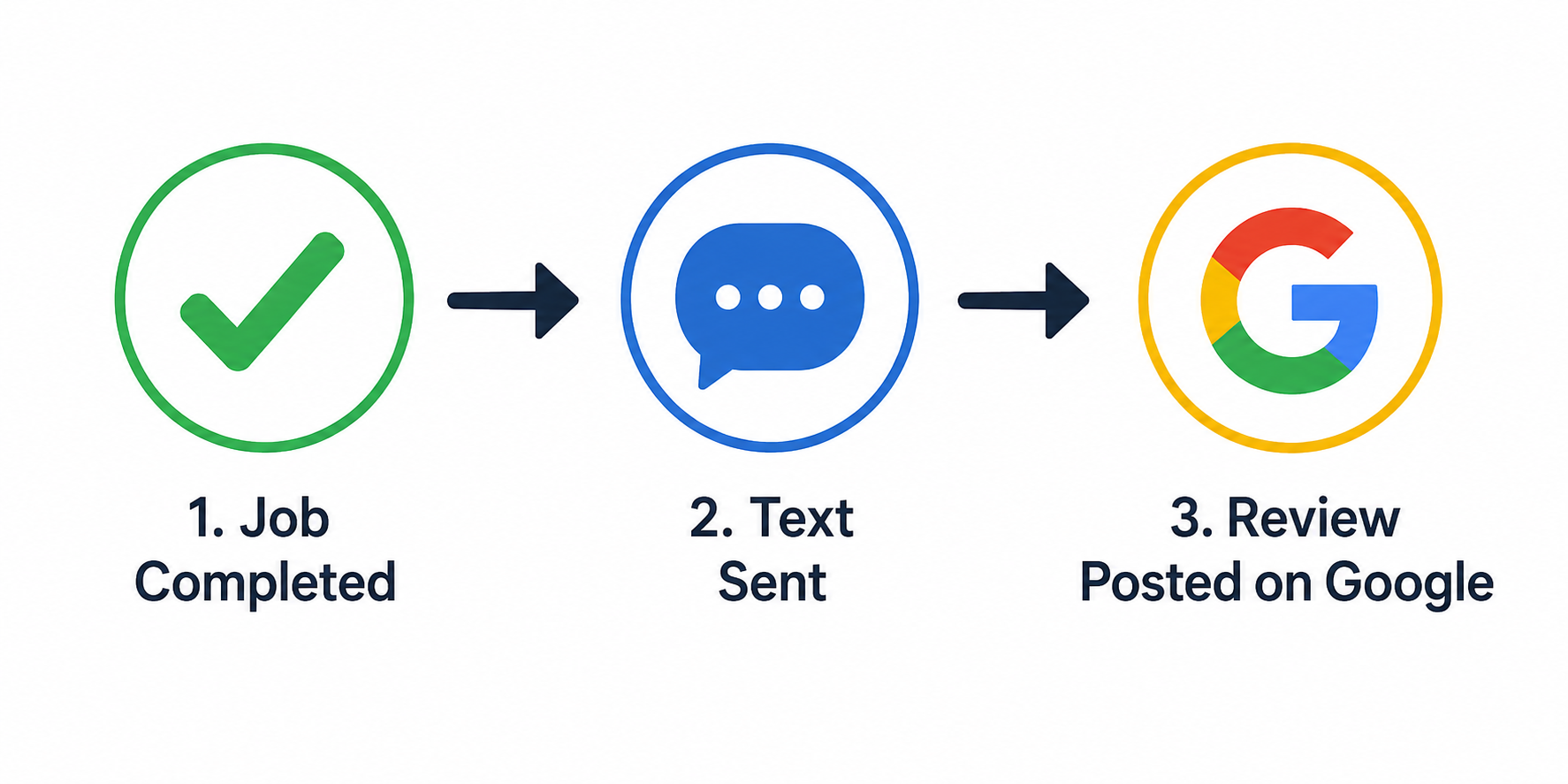
This sounds more complicated than it is. At its core, an automated review system does one thing: it removes the "remembering" part for both you and your customer.
Here's the basic flow:
1. A customer completes a job, makes a purchase, or finishes an appointment
2. Within a set window — usually within a few hours, or the next morning — the system automatically sends them a text message or email
3. That message asks how things went and includes a direct link straight to your Google review page
4. The customer taps the link, and they're already on the page where they can leave a star rating and a few words — no searching, no navigating, no extra steps
That's it. No one has to remember to ask. No one has to remember to follow up. The request goes out the same way, every time, whether you had a slow day or your busiest day of the month.
The other piece worth knowing about: a good system also gives unhappy customers a private way to flag a problem before it turns into a public one-star review. If someone's response signals they're not satisfied, that feedback can route to you directly instead of straight to Google — giving you a chance to make it right before it becomes part of your public rating.
Three things you can do right now, no software required
You don't need to wait until you've set up automation to start improving your review numbers. These work on their own, and they make any automated system even more effective once you do have one.
Time the ask for right after the win. The best moment to ask for a review is the moment your customer is happiest with your work — right after the job is done, the product is delivered, or the appointment wraps up. Don't wait a week. By then the feeling has faded and your business has slipped down their mental list. If you're doing this manually, build it into your routine: the last thing you say or text after every job is some version of "thanks for choosing us — would you mind leaving us a quick review?"
Make it a one-click process. The single biggest reason people don't leave reviews isn't that they don't want to — it's that it's annoying. If someone has to open Google, search for your business name, find the right listing, and then figure out where the "write a review" button is, you've lost most of them. Get your direct Google review link (you can generate this from your Google Business Profile) and send that exact link to customers, whether by text, email, or even just copying it into a message. The shorter the path between "I'm willing to leave a review" and "review submitted," the more reviews you'll actually get.
Respond to every review — good and bad. This one doesn't get you more reviews directly, but it makes every review you do get work harder for you. When someone sees that you reply to reviews — thanking people for positive ones, addressing concerns on negative ones professionally — it tells future customers two things: you're an active business that pays attention, and you're the kind of business that handles problems well instead of ignoring them. A handful of reviews with thoughtful responses often builds more trust than a big pile of reviews nobody ever replied to.
How Velocity Designs handles this end-to-end
The tips above will move the needle, but they all still rely on you remembering to do them, every time, for every customer. That's the part automation takes off your plate entirely.
Our review automation connects to how your business already operates. After a job, appointment, or purchase, the system automatically sends your customer a text or email at the right moment, with a direct link straight to your Google review page — no searching, no extra steps. Happy customers get routed straight to leaving a public review. If someone signals they're unhappy, that feedback comes to you privately first, so you can fix it before it becomes a one-star post for everyone else to see.
Every review — Google, Facebook, and other platforms — shows up in one dashboard, so you always know what's being said about your business and where. Most clients see new reviews coming in within the first week, and within 90 days, many have collected more reviews than they had in the previous couple of years combined.
Setup takes less than a day, and once it's running, it just keeps working in the background — no extra effort from you, no extra step for your customers.
If your review count doesn't reflect how good your work actually is, that's not a "you" problem — it's an asking problem, and it's an easy one to fix. Check out how our review automation works, or get in touch and we'll walk you through what it would look like for your business.