Lead Generation for Small Business: Find Your Sources
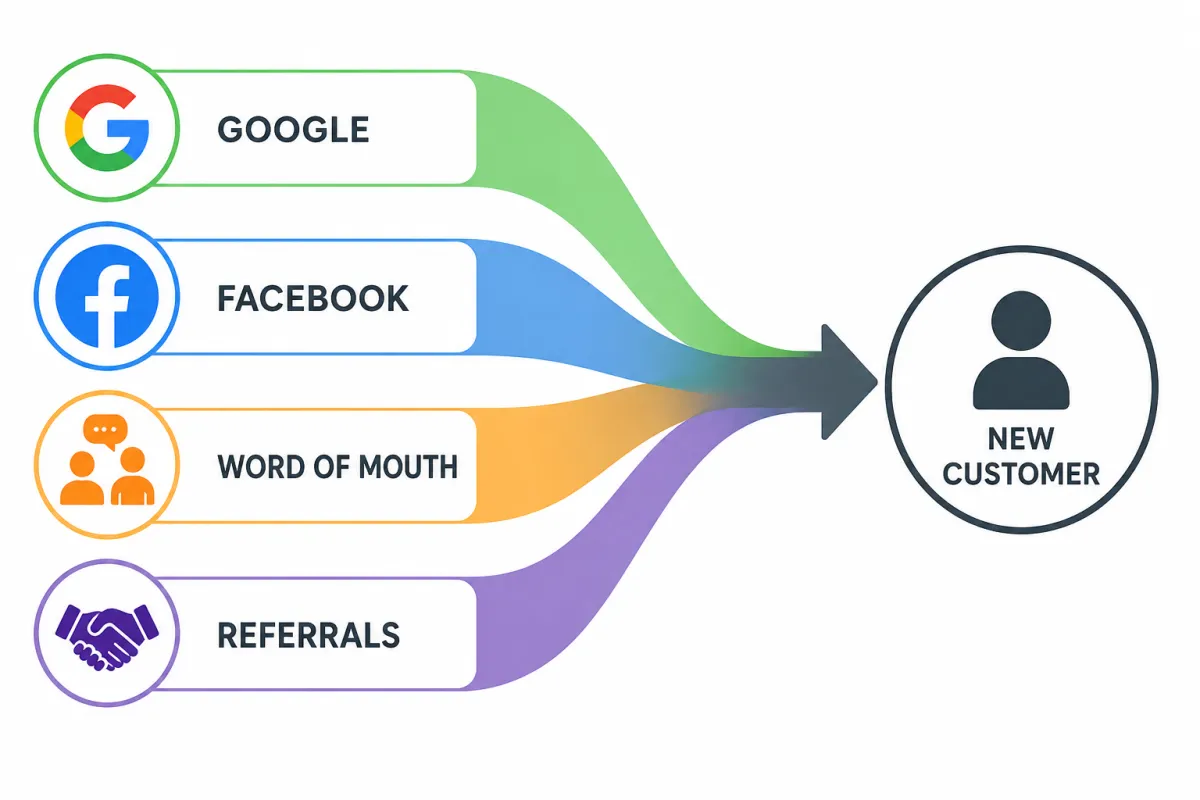
Ask most small business owners where their customers come from, and you'll get some version of "word of mouth, mostly. And Google, I think. And we're on Facebook too." It's not a wrong answer — it's just not a useful one.
If you don't know which of those is actually doing the work, you can't double down on what's working or fix what isn't. You're spending time and money across a handful of channels and hoping the mix is right, without any real way to check.
That's normal. Most small businesses get to this point because they started doing a little bit of everything — a Facebook page here, a Google listing there, some flyers, a referral program that's really just "tell your friends" — and it all blurred together over time. The fix isn't complicated, but it does take a little intention.
Why this matters more than it seems
Let's say you're spending time posting on social media every week, and you're also paying for a service that helps with reviews, and your website gets some traffic from Google. If a new customer calls, do you know which of those got them to pick up the phone?
If the answer is "no idea," here's what that costs you. You might be spending hours every week on social media posts that aren't bringing in a single customer, while your Google listing — which takes ten minutes a month to maintain — is quietly generating most of your business. Or it could be the other way around. Without knowing, you're guessing, and guessing means you could be putting your time into the wrong place.
It also matters when you're deciding where to spend money. If you're thinking about running ads, or paying for a directory listing, or investing in SEO, knowing where your current customers come from tells you whether that's doubling down on something that works or branching into something untested. Both can be the right call — but only if you know which one you're doing.
Simple ways to start tracking

You don't need software or a dashboard to start. The easiest method is also the most overlooked: ask.
Ask new customers how they found you. This can be as simple as adding one line to your intake process — "quick question, how'd you hear about us?" Most people will tell you without hesitation, and a few weeks of answers will start showing you a pattern. Was it a Google search? A friend's recommendation? They saw your truck? They found you on Facebook? Write it down somewhere, even if it's just a notebook by the phone or a column in a spreadsheet.
Pay attention to where your calls and form submissions come from. If someone calls the number on your website, that's a different lead source than someone who calls because a neighbor gave them your number. If your website has a contact form, look at what people typed — sometimes they'll mention "I saw your site come up when I searched for..." which tells you a lot on its own.
Check your Google Business Profile insights. If you have a Google Business Profile set up (and if you don't, that's worth fixing first), it shows you how many people viewed your listing, clicked through to your website, requested directions, or called directly from the listing. That's a real number, not a guess.
Look at what your reviews say. Sometimes customers mention how they found you right in their review — "found this place on Google" or "my coworker recommended them." It's a small detail, but over a few months of reviews, it adds up to a pattern.
None of this needs to be perfect. Even a rough sense of "most of our new business comes from X" is more useful than not knowing at all.
Why one channel alone isn't enough
Here's the part that trips people up once they start tracking: it's rarely just one thing. The businesses that grow steadily usually have a few channels working together, each reinforcing the others.
Someone searches for your service on Google and finds your website. Before they call, they check your reviews to make sure you're legit. If your reviews are solid, that builds the trust your website started. Maybe they also see your business mentioned on a local Facebook group, which adds another layer of "okay, I've seen this name before." By the time they reach out, it doesn't feel like one channel did the work — it feels like they just naturally landed on you.
That's the compounding effect. A website that shows up in search, a steady stream of reviews, and some presence on social media all reinforce each other. Take one away, and the whole thing gets weaker — not because that one channel was doing everything, but because it was part of how the others built trust.
This is also why "we tried Facebook ads for a month and it didn't work" doesn't always mean Facebook ads don't work for your business. It might mean the ad sent someone to a website that didn't load well on their phone, or to a Google Business Profile with no reviews, so they bounced before ever reaching out. The channels aren't really separate — they're connected.
What to do next
Start simple. For the next month, ask every new customer how they found you, and write it down. At the same time, check your Google Business Profile insights if you have one set up. After a month, you'll likely see a pattern start to form — and that pattern tells you a lot about where to focus your time and money going forward.
If you want help building out a coordinated approach — website, SEO, reviews, and social media all working together instead of as separate disconnected efforts — check out our lead generation page for how we approach it, or get in touch and we'll talk through what's likely to move the needle for your business specifically.